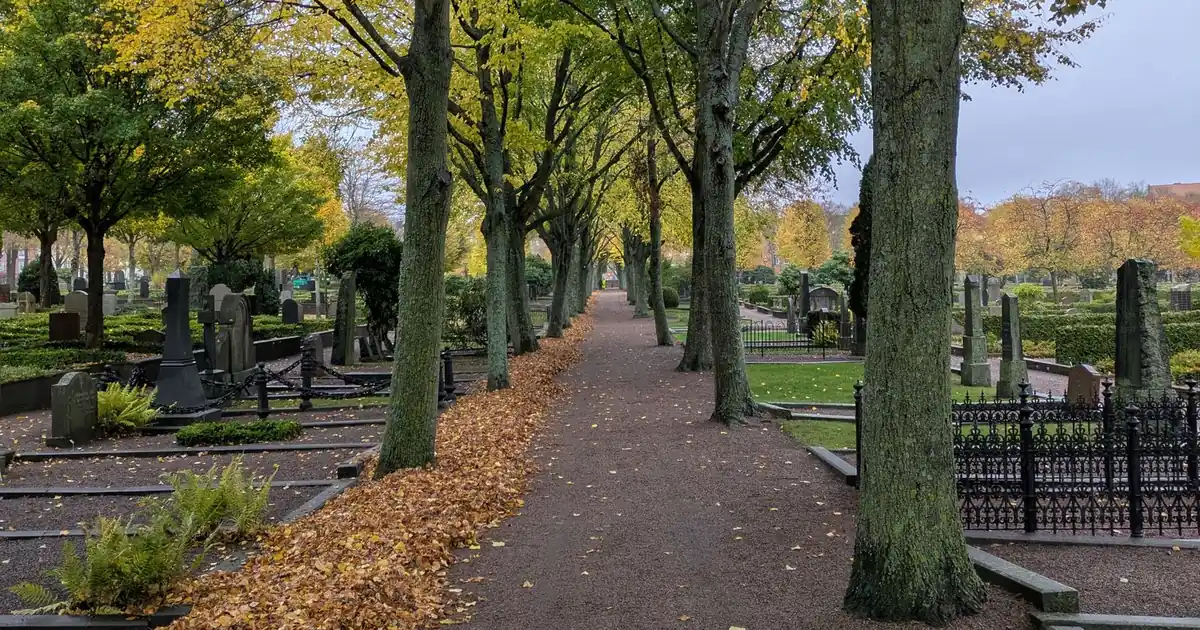
Introduction
When the days grow shorter and the summer flowers on the grave have faded, many bereaved families face the same quiet question: what do I do with the grave now? For most people, winter grave planting is not gardening. It is a form of remembrance — a way of continuing to care, in one particular place, for someone who is no longer here. And that is precisely why it can feel heavy, especially in the first years after a loss.
This article walks you through the practical side: the planting window, plants that genuinely withstand frost, what the fir covering is for, what your cemetery bylaw says about plastic and grave lights, and what a cemetery nursery charges.
One reassurance first: All Saints' Day and Totensonntag are memorial days, not legal deadlines. Nobody need feel guilty if the grave has not been prepared for winter by 1 November. What is genuinely obligatory we set out further below — with a reference to the source in each case.
When to Do the Winter Grave Planting — the Window and the 2026 Dates
You normally set winter grave planting between September and November, while the ground is not yet frozen. Covering with fir brushwood usually follows from the second half of November. In 2026, All Saints' Day falls on Sunday 1 November and Totensonntag on Sunday 22 November.
These timings are a guide, not a fixed deadline. For winter heath, the classic hardy grave plant, the plant portal Plantura names autumn as the best planting time: 'It is best to plant winter heath in autumn, between September and November.' The garden guide published by t-online describes the transition into winter this way: 'From the second half of November at the latest, the late bloomers on the grave are replaced by the winter covering and lasting arrangements.' When that is possible where you live depends on region and weather — at higher altitudes the ground freezes earlier.
Dates in Autumn and Winter 2026
| Occasion | Date in 2026 | Day | Meaning | Public holiday? |
|---|---|---|---|---|
| Allerheiligen (All Saints' Day) | 1 November | Sunday | Catholic memorial day, blessing of the graves | yes, in Baden-Württemberg, Bavaria, North Rhine-Westphalia, Rhineland-Palatinate and Saarland |
| Volkstrauertag (National Day of Mourning) | 15 November | Sunday | remembrance of war dead and victims of violence | no |
| Totensonntag / Ewigkeitssonntag (Sunday of the Dead) | 22 November | Sunday | Protestant memorial day, last Sunday of the church year | no, but protected as a day of quiet in every federal state — the extent of the restrictions differs under state law |
| First Sunday of Advent | 29 November | Sunday | beginning of the new church year | no |
Sources: timeanddate.de on All Saints' Day, schulferien.org on Volkstrauertag and schulferien.org on Totensonntag. Because All Saints' Day falls on a Sunday in 2026, its status as a public holiday makes little difference under employment law — for cemetery visits themselves nothing changes.
If you would like to commission a cemetery nursery (Friedhofsgärtnerei), enquire early — October and November are their busiest season. What each of these memorial days means is set out in our overview of the memorial days in Germany — Totensonntag, All Saints' Day and Volkstrauertag.
Hardy Grave Plants: What Survives the Frost — and What Only Looks as Though It Will
Hardy plants include winter heath (Erica carnea), Christmas rose (Helleborus niger), lesser periwinkle (Vinca minor), bearberry cotoneaster and checkerberry. Not hardy, by contrast, are Cape heath (Erica gracilis), sold in vast quantities each autumn, the florist's cyclamen (Cyclamen persicum) and cushion bush (Calocephalus brownii) — they do not survive heavier frost outdoors.
The most common mistaken purchase in autumn concerns heather. In everyday speech a great many plants are called 'Erika'; botanically they are quite different. Cape heath (Erica gracilis), also sold as ornamental or bell heather, comes from the Cape region of South Africa according to Hausgarten.net and freezes at temperatures below minus 6 degrees; indoors it is overwintered at 5 to 10 degrees. In practice it is a seasonal plant. Winter heath (Erica carnea), by contrast, is a hardy evergreen dwarf shrub: according to Plantura it tolerates 'temperatures down to -30°C without difficulty', and according to the same portal's guide to winter grave planting it flowers from December into April.
A second name adds to the confusion: what is sold as bud heather (Knospenheide) or bud-flowering heather is botanically common heather (Calluna vulgaris) — and that is hardy. Only Cape heath (Erica gracilis) is not. Both stand side by side on the shelf in autumn, which is why it is worth reading the label.
Our advice: at the garden centre, ask for the botanical name on the label rather than for 'Erika'. The same applies to cyclamen. According to the nursery Lubera, the florist's cyclamen (Cyclamen persicum) commonly sold in shops originates in the Mediterranean and is sensitive to frost — temperatures below zero can damage the leaves and the tuber. Only certain wild species such as Cyclamen coum or Cyclamen hederifolium are hardy.
Overview: Hardy and Non-Hardy Grave Plants
| Plant | Botanical name | Hardy? | Flowering / decorative value | Note |
|---|---|---|---|---|
| Winter heath, snow heath | Erica carnea | yes | December to April | tolerates down to -30°C |
| Christmas rose | Helleborus niger | yes | from November | flowers even in frost and snow |
| Common heather, sold as 'bud heather' | Calluna vulgaris | yes | August to the end of January | hardy — do not confuse with Cape heath |
| Lesser periwinkle | Vinca minor | yes | dark green all year | dense permanent ground cover |
| Bearberry cotoneaster | Cotoneaster dammeri | yes | red berries in winter | low, wide-spreading ground cover |
| Checkerberry, wintergreen | Gaultheria procumbens | yes | fiery red berries | a note of colour in the dark season |
| Stonecrop | Sedum | yes | seed heads through winter | frost-hardy to roughly -20°C |
| Barren strawberry | Waldsteinia ternata | yes | evergreen | low-maintenance ground cover |
| Snowdrop | Galanthus | yes | January to March | set the bulbs in autumn |
| Winter aconite | Eranthis hyemalis | yes | February | early yellow flowering |
| Cape heath, ornamental heath | Erica gracilis | no | August to October | native to South Africa, freezes below -6°C, in practice a seasonal plant |
| Florist's cyclamen | Cyclamen persicum | no | autumn until frost | frost damages leaves and tuber; only wild species such as Cyclamen coum are hardy |
| Cushion bush, silver bush | Calocephalus brownii | no | silvery all year | overwinter frost-free, at 5 to 15°C in winter |
The botanical details draw on Plantura: Grabbepflanzung im Winter and the same portal's profile of winter heath, on Hausgarten.net for Cape heath, and on Floragard for cushion bush: there it states that in winter the temperature may 'fall to 5°C to 15°C', and that beds and containers should only be replanted 'once no further frosts are to be expected'.
Covering the Grave with Fir Brushwood: Winter Decoration and Frost Protection in One
A grave covering of fir or spruce brushwood serves two purposes: it decorates the open bed areas during the dark season and protects the permanent planting from frost, wind and winter sun. Cemetery nurseries prepare graves for this in autumn — in good time before the November memorial days.
Getting the emphasis right matters, so that you do not put yourself under pressure. The cemetery nursery Halkier in Magdeburg describes the covering above all as decoration for the open areas during the dark season — and, alongside that, as important winter protection. Its decorative character therefore comes first. The grave covering is a choice, not a horticultural obligation — permanent planting of hardy perennials will in principle survive the winter without it. According to Halkier, noble fir and other conifer varieties are used, sometimes with strips of Iceland moss.
Step by Step: Preparing the Grave for Winter
- Remove the dead summer planting. Several cemetery bylaws require this in any case. In Munich, section 38 (2) of the cemetery bylaw puts it briefly: 'Wilted flowers and wreaths are to be removed from the graves.' Saarbrücken (section 27 (1) of the bylaw of 8 December 2020) and Lüneburg (section 34 (5)) additionally name arrangements and require their prompt removal.
- Loosen the bed and clear the leaves. Wet, compacted leaves encourage rot in the permanent plants.
- Set the hardy plants — while the ground is not yet frozen (see the window above).
- Lay the covering. Brushwood is laid loosely and overlapping like roof tiles, so that water can run off and the plants beneath receive air.
- Remove it in spring, once the last snow has melted, so that the early flowers get light.
One point many people overlook: the winter covering itself may fall under the bylaw's plastic ban. The cemetery bylaw of the Hanseatic City of Lüneburg expressly names 'grave coverings' in section 34 (9), alongside wreaths, arrangements and grave borders, as areas in which plastics may not be used. Anyone working there with plastic matting or plastic-bonded ready-made covers risks an objection.
Two further sets of rules target the covering itself. In section 37 (3) a) of its cemetery bylaw, the City of Munich prohibits not only artificial grave decoration but also 'covering graves with sheeting or netting'. The model cemetery bylaw of the Evangelical Church of Westphalia prohibits, in section 21 (5), 'covering the grave with materials that prevent the ventilation and watering of the soil'. Fir or spruce brushwood is not affected: it rots down and lets air and water through — which is precisely why it is laid loosely and overlapping.
What the Cemetery Bylaw Says About Plastic in Winter Grave Decoration
There is no nationwide ban on plastic at German cemeteries. What always governs is the cemetery bylaw (Friedhofssatzung) of your cemetery operator. Many bylaws expressly prohibit plastic in grave decoration — Munich, Saarbrücken, Lüneburg and the model bylaw of the Evangelical Church of Westphalia all do so. Other rules tolerate grave lights with a plastic casing.
The sentence 'plastic is banned at the cemetery' is therefore too crude — and within one and the same bylaw, different rules may apply to arrangements and to grave lights. The overview below sets out five verified sets of rules in their own words.
| Operator | Rule | Wording / reference | As at |
|---|---|---|---|
| City of Munich | artificial grave decoration made of non-rotting materials prohibited | section 37 (3) a) prohibits 'the use of artificial grave decoration of any kind that consists, wholly or in part, of non-rotting materials' (municipal law no. 800) | version of 2 December 2021 |
| City of Saarbrücken | grave decoration only from rotting materials | section 26 (6): 'Wreaths, arrangements, flowers or other grave decoration may consist only of rotting and biodegradable materials.' | bylaw of 8 December 2020 |
| Hanseatic City of Lüneburg | the plastic ban expressly covers grave coverings too; LED and solar grave lights prohibited, plastic grave lights with a candle permitted | section 34 (8)-(10), among others: 'Mourning decoration and grave lights may furthermore not be used if they contain electronics (e.g. LED light, solar cells). [...] Grave lights made of plastic with candles may be used.' | council resolution of 22 December 2022 |
| Town of Bornheim | no plastics in grave decoration, but grave lights with a plastic casing are tolerated | 'Grave lights with a plastic casing are tolerated; the burnt-out casings belong in residual waste.' | information notice of 25 October 2023 |
| Evangelical Church of Westphalia | general exclusion of plastic in the model cemetery bylaw | section 21 (3): 'The use of plastics for grave design and as grave decoration is prohibited.' | model bylaw of 23 August 2018 |
Sources in the original wording: Munich cemetery bylaw (municipal law 800), Saarbrücken cemetery bylaw, Lüneburg cemetery bylaw, Town of Bornheim and the model cemetery bylaw of the Evangelical Church of Westphalia. The quotations are our translations of the German originals.
Two points of context. First, the Westphalian rule is a model bylaw — each parish must first adopt it for its own cemetery. Second, it is not possible to quantify how many cemeteries in Germany prohibit plastic; we are not aware of any nationwide survey. All that can be said with confidence is that many bylaws contain such a rule — so read your own cemetery's bylaw before you buy. The bylaw also governs the fees; how widely these differ between cities is shown in our comparison of cemetery fees in Germany.
Where decoration may be laid is also regulated in some places. On 6 July 2026 the City of Saarbrücken announced that flowers, arrangements, grave lights and personal items at lawn graves, communal urn plots, urn pyramids and urn walls may be placed only on designated laying areas.
A Special Case — Grave Lights: Munich Currently Prohibits Battery-Powered Lights Too
On 26 June 2026, Munich's municipal cemeteries issued a ban on all grave lights because of persistent drought — free-standing candles, candles in lanterns and battery-powered lights alike. As at September 2026, no repeal is known. Check before All Saints' Day whether the measure still applies.
The official Rathaus-Umschau (city hall bulletin) of 26 June 2026 states that the municipal cemeteries are issuing 'with immediate effect a ban on all grave lights on the cemetery grounds'. Battery-powered lights are covered too, on the following reasoning: 'From a distance these cannot be distinguished from burning candles and make rapid hazard assessment and intervention by cemetery staff more difficult.' The city additionally appeals to visitors not to smoke on cemetery grounds.
Two points of context matter to us. First, this is a municipal, weather-dependent measure — not a permanent change to the bylaw and not a Bavaria-wide or nationwide rule. The same order was issued on 1 July 2025, likewise for all municipal cemeteries and likewise on grounds of drought. Second, it has no end date; the city has not named one. As at 4 September 2026 we found no report of a repeal — that is a negative finding, not evidence that the ban will still be in force at All Saints' Day. A quick call to the cemetery administration before your visit is worthwhile.
If you read in guides — including our own older articles — that grave lights should be placed or replaced in November, please note that this advice does not hold everywhere. Lüneburg permanently prohibits electronic grave lights by bylaw but permits plastic lights holding a real candle; Saarbrücken allows grave lights at communal plots only on designated laying areas.
Are All Saints' Day and Totensonntag a Deadline You Must Meet?
No. All Saints' Day and Totensonntag are traditional memorial days, not legal deadlines. In the cemetery bylaws we examined there is no duty to cover the grave by any particular date. The only binding obligation is general maintenance: graves must be laid out and kept permanently in good order.
We read the bylaws of Munich (version of 2 December 2021), Saarbrücken (8 December 2020) and Lüneburg (22 December 2022) in full. None of the three requires the grave to be covered or winter-planted by All Saints' Day, by Totensonntag or by any other date. We cannot make a blanket claim for other operators — these three are the ones we checked.
There is, however, very much a general duty of care. In its guide to comparing services and prices of cemetery gardeners (as at January 2026), the consumer initiative Aeternitas states: 'Cemetery bylaws provide for an obligation to maintain the grave, in order to prevent graves from falling into neglect.' Where this is not met, Aeternitas notes that the consequences may include restoration carried out at the grave holder's expense, revocation of the grave usage right (Grabnutzungsrecht) and, in some cases, treatment as a regulatory offence. Lüneburg sets this out in section 34 (1) of its cemetery bylaw: the grave must be laid out within six months of the burial and kept permanently in a safe condition.
In practice this means: a grave with no arrangement on it in December is not a problem. A grave left neglected for years very much is. And wilted flowers and wreaths must be removed under several bylaws — in Saarbrücken and Lüneburg expressly without delay. That is the most concrete duty affecting the winter months.
What Winter Planting Costs — Doing It Yourself or Commissioning a Cemetery Gardener
According to Aeternitas, annual grave maintenance by a cemetery gardener costs roughly 75 to 750 EUR per grave plot, depending on the provider and the scope agreed. The winter covering is not automatically included — with some providers it appears only in the most expensive package. Ask for the individual services to be itemised in writing.
Aeternitas states the range with express caution: 'The usual prices for annual grave maintenance lie, depending on the provider and the agreed scope of work, between approximately 75 and 750 euros per grave plot. This figure is only a rough guide.' It is therefore neither an average nor a market price. What matters is which items appear in the contract — and the winter covering is a line of its own there.
Checklist: Which Items Appear in Your Quotation?
This list follows the Aeternitas price comparison form and adds the winter-relevant items — ask for every line to be confirmed.
| Service | Included in the quotation? | Price as quoted |
|---|---|---|
| Annual grave maintenance (weekly / fortnightly / monthly / every six weeks) | yes / no | |
| Autumn planting | yes / no | |
| Winter grave covering (fir / spruce) | yes / no | |
| Watering service | yes / no | |
| Grave decoration for the memorial days (arrangement / bouquet) | yes / no | |
| Fertiliser and compost for the planting bed | yes / no | |
| Cleaning of the memorial stone | yes / no |
For orientation, some named market examples — regional individual prices, expressly not national averages:
- Gärtnerei Schanbacher, Schorndorf-Weiler (Baden-Württemberg), guide prices for 2026 including 19 per cent VAT, per year: basic maintenance from 165 EUR (urn grave), 220 EUR (single grave), 290 EUR (double grave). The 'Klassik' package from 390, 530 and 680 EUR includes three seasonal replantings with plants and soil as well as watering from May to September. Winter covering with fir brushwood and an arrangement only appears in the 'Komplett' package from 490, 650 and 820 EUR — so a mid-range package need not include it.
- Cologne Cemetery Gardeners' Cooperative (Genossenschaft Kölner Friedhofsgärtner): annual maintenance from 345 EUR. For autumn planting — the season this article is about — the cooperative quotes 60 to 70 EUR (simple bed) and 65 to 80 EUR (mixed bed); in spring and summer the figures are 45 to 55 and 50 to 65 EUR respectively. A structured bed costs 75 to 125 EUR regardless of season. Winter services are not itemised separately there.
- Friedhofsgärtnerei Bell, Recklinghausen district: annual maintenance including VAT from 110 EUR (assigned urn grave) to 260 EUR (two-plot selected grave); 'covering the grave with decorative pine bark or grave soil' costs 30 EUR per plot. Here, though, covering with bark or soil is meant, not with fir brushwood.
- Grave decoration and winter covering as separate items: Gärtnerei Schanbacher quotes 'grave decoration for a memorial day (bowl, bouquet or arrangement)' from 29 EUR and 'winter covering with fir brushwood incl. arrangement' at 69 EUR (urn grave), 99 EUR (single grave) and 129 EUR (double grave). In mail order, ready-made grave arrangements start at just under 30 EUR, for instance at 24blooms; larger, hand-bound work costs considerably more there.
There is no nationwide price for a winter covering with fir brushwood — the figures above are guide prices from individual businesses, and every grave is laid out differently. So ask for a written quotation containing the separate item 'winter grave covering'. When a long-term grave care contract is worthwhile is set out in our guide to grave maintenance costs and long-term grave care.
If You Live Far from the Cemetery
If you live a long way away, you can hand the winter planting over to a cemetery nursery or a long-term grave care contract. Aeternitas advises paying attention to trust-held funds, supervised maintenance, account statements and a final invoice. For remembrance itself, by contrast, you do not need the journey to the grave.
Many families today are spread across several cities or countries. The question is then not whether you are doing enough, but how the task is shared. The physical care — planting, covering, watering, an arrangement for the memorial days — can be handed over by contract. Make sure the winter covering appears as a separate item in that contract.
Remembrance independent of place A nursery takes on the work at the grave. Remembrance itself can also be made visible — with a digital memorial page bringing together photographs, life dates and memories from relatives, regardless of how far away anyone lives. A QR code on the headstone leads visitors straight there. Read more about digital remembrance on Kinmory →
Whether you stand at the grave on Totensonntag or think of the person who has died from far away makes no difference to remembrance. Which forms are customary in the German mourning context is described in our guide to funeral attire in Germany.
Frequently Asked Questions
By when must I prepare the grave for winter?
There is no legal deadline. All Saints' Day (1 November 2026) and Totensonntag (22 November 2026) are traditional memorial days, not dates prescribed by any cemetery bylaw. From a gardening point of view it makes sense to set hardy plants between September and November, while the ground is not yet frozen. The fir covering usually follows from the second half of November.
Is plastic grave decoration banned at German cemeteries?
There is no nationwide ban — what matters is the cemetery bylaw (Friedhofssatzung) of your cemetery operator. Munich, Saarbrücken and Lüneburg expressly prohibit plastic in grave decoration, as does the model bylaw of the Evangelical Church of Westphalia. Other operators are more tolerant: Bornheim tolerates grave lights with a plastic casing. Ask the cemetery administration before you buy, or read the bylaw online.
Is heather (Erika) frost-hardy?
It depends on the species, and this is where the most common mistaken purchase happens. Cape heath (Erica gracilis), sold in vast quantities each autumn, originates in South Africa and, according to Hausgarten.net, freezes at temperatures below minus 6 degrees. Winter heath (Erica carnea) is hardy: according to Plantura it tolerates down to minus 30 degrees and flowers from December to April. Do not confuse them: the plant sold as bud heather is botanically common heather (Calluna vulgaris) and is hardy.
May I place grave lights in winter?
Usually yes, but not everywhere. Munich's municipal cemeteries banned all grave lights on 26 June 2026 because of drought — battery-powered lights included; as of September 2026 no repeal is known. Lüneburg permanently prohibits grave lights with LEDs or solar cells but allows plastic lights holding a real candle. Check with your cemetery administration before All Saints' Day.
What does winter planting by a cemetery gardener cost?
The consumer initiative Aeternitas gives a rough guide of 75 to 750 EUR per grave plot for annual grave maintenance. Winter covering with fir brushwood is a separate line item and is not automatically included — with some providers it only appears in the most expensive package. Ask for a written quotation itemising every individual service.
Summary
- The window: set hardy plants as a rule between September and November, with the brushwood covering usually from the second half of November — depending on region and weather.
- Dates in 2026: All Saints' Day 1 November, Volkstrauertag 15 November, Totensonntag 22 November, first Sunday of Advent 29 November (each a Sunday).
- Choice of plants: Erica carnea (winter heath) is hardy and tolerates down to -30°C; the usual autumn 'Erika' is Cape heath, Erica gracilis, and freezes below -6°C — equally non-hardy are Cyclamen persicum and Calocephalus brownii. The bud heather sold in shops is botanically Calluna vulgaris and is hardy.
- Plastic: no nationwide ban, but many bylaws prohibit it — verified for Munich, Saarbrücken, Lüneburg and the Westphalian model bylaw. Bornheim tolerates grave lights with a plastic casing.
- Grave lights: since 26 June 2026 Munich has prohibited all grave lights including battery-powered ones — a municipal, weather-dependent measure; as at September 2026 no repeal is known.
- No deadline: All Saints' Day and Totensonntag are memorial days. The only obligations are permanent laying out and upkeep of the grave, and the removal of wilted flowers and wreaths.
- Costs: Aeternitas gives a rough guide of 75 to 750 EUR per grave plot per year. The winter covering is a contract item of its own — ask about it expressly.
Note: all price and legal information in this article reflects the position as at 4 September 2026 and relates to Germany. Cemetery bylaws, fees and gardeners' prices are set independently by the respective operators and businesses and may change at any time. Munich's grave light ban of 26 June 2026 has no end date — please check with your cemetery administration before All Saints' Day whether it still applies. Always read the current bylaw of your cemetery operator, or ask there directly.
Sources
- Munich cemetery bylaw (Friedhofssatzung, municipal law no. 800) — section 37 (3) a), section 38 (2).
- Saarbrücken cemetery bylaw of 8 December 2020 — section 26 (6), section 27 (1).
- Lüneburg cemetery bylaw — section 34 (1) and (8) to (10).
- Town of Bornheim: grave decoration without plastic (25 October 2023).
- Model cemetery bylaw of the Evangelical Church of Westphalia, 23 August 2018 — section 21 (3) and (5).
- Rathaus-Umschau Munich no. 119 of 26 June 2026 — ban on all grave lights.
- Aeternitas e. V.: price comparison for grave maintenance by cemetery gardeners (as at January 2026) — price guidance, service items, duty of care.
- Plantura: Grabbepflanzung im Winter and Plantura: Schneeheide — hardiness, flowering period and planting time.
- Hausgarten.net: Glockenheide — origin and frost hardiness of Erica gracilis; Floragard: Calocephalus brownii — overwintering temperature.
Further Reading
- Grave Maintenance Costs in Germany 2026 — Annual and Long-Term Care Prices
- Memorial Days in Germany — Totensonntag, All Saints' Day and Volkstrauertag
- Cemetery Fees in Germany — Costs by City and Grave Type 2026
- Funeral Attire — What to Wear to a Funeral in Germany
Add a QR Code to the Headstone
A digital memorial on Kinmory makes visible what does not fit on a headstone: photographs, a life story and memories shared by relatives. A QR code on the headstone leads visitors there — even when the family is spread across many cities.
See digital remembrance on Kinmory →